
Nobody Does the Math Out Loud. Allow Me.
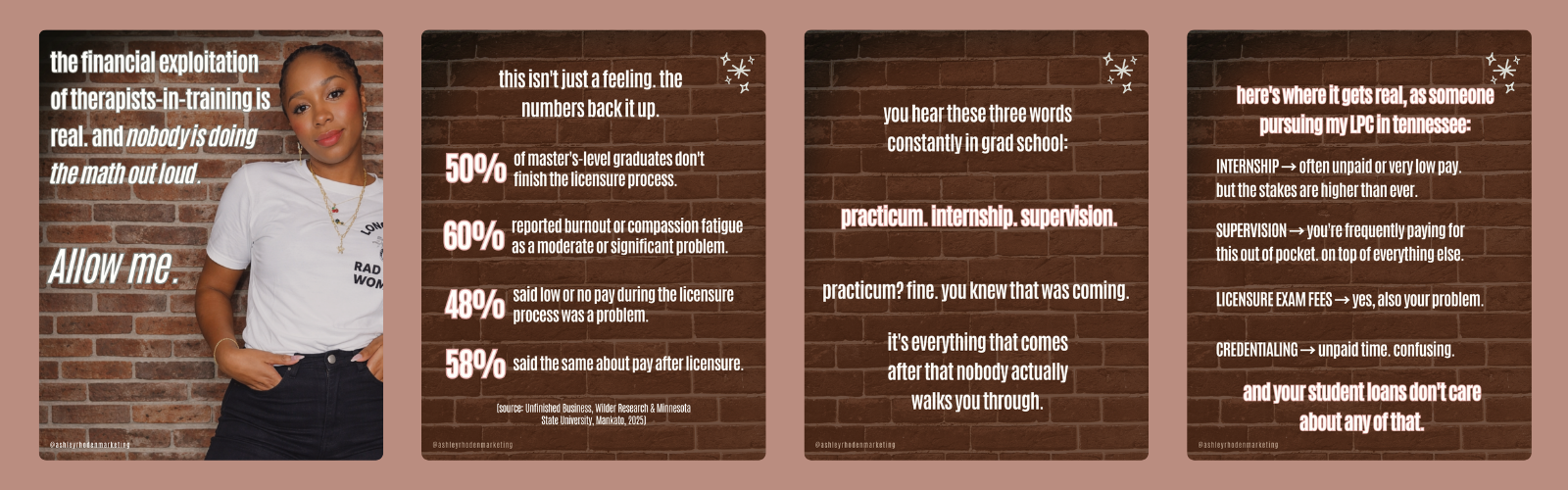
The financial exploitation of therapists/counselors-in-training is real — and the system is counting on you not to add it up.
I'm pursuing my LPC in Tennessee. I knew going in that it would be hard. I knew there would be supervised hours and exams and a long road between grad school and actually practicing. I knew I'd be learning things that would take years to fully understand.
What I didn't know — what nobody really sat me down and explained — was how much of that road I'd be paying for out of pocket, while also working for little to nothing, while also somehow staying sane enough to sit with other people's pain. Nobody does that math out loud. So let me.
The Three Words They Repeat in Grad School
Practicum. Internship. Supervision. You hear them constantly. They're framed as milestones, proof you're becoming a real clinician. And in a lot of ways, they are. The work you do during those years matters. The clients are real. The growth is real. But so is the financial reality that nobody walks you through.
Internship is often unpaid. Or close to it. You're doing the hardest, most emotionally demanding work of your early career in high-pressure environments, with real clients, real stakes — and the compensation frequently doesn't reflect that. And because you're technically a student, you can't always pick up extra work to make up the difference.
Supervision — the thing you literally cannot become licensed without — you're often paying for yourself. Out of pocket. On top of tuition. On top of living expenses. On top of student loans that are already accruing interest.
Licensure exam fees are also your problem. Yes, all of them.
Credentialing, when you finally get there, is unpaid time spent navigating a confusing process that no one fully prepares you for.
And through all of it: your student loans don't care. They don't pause for your internship. They don't give you a discount for supervising someone else's clients for free.
This Isn't Just a Feeling
I want to be clear: this isn't just my experience, or a few people venting in a group chat.
A 2025 Minnesota study called Unfinished Business* — from Wilder Research and Minnesota State University, Mankato — surveyed master's-level graduates across the state and found that about half don't finish the licensure process. The researchers identified low or no pay during the licensure process as a problem for 48% of respondents. And 58% said the same about pay after licensure.
Burnout and compassion fatigue? Moderate or significant problem for 60% of the people surveyed.
The sample is Minnesota-specific, but the financial dynamics it describes are consistent with what mental health providers report across the country.
These aren't outliers. This is the pipeline.
And No One Is Coming to Save You
That's the part that's hardest to sit with. The system isn't broken by accident. It's structured in a way that requires you to absorb significant financial and emotional cost in order to enter a profession that is chronically underpaid even once you're licensed. And the people benefiting from your unpaid or low-paid labor — agencies, group practices, training sites — have very little incentive to change that.
That's not a you problem. That's a structural problem. But structural problems still land on individual people. On you, figuring out how to cover supervision fees. On you, doing the math at 11pm and wondering if it's worth it. On you, burning out before you've even started.
So Why Am I Writing About This on a Marketing Website?
Fair question.
Here's the honest answer: I work with therapists on their websites and online presence. Most of the people I talk to are licensed, in private practice, trying to figure out how to fill their caseload. And almost all of them come to me carrying the same thing, a deep exhaustion with a system that undervalued them from day one, and a complicated relationship with asking to be paid what they're worth.
That's not a coincidence. When you spend years being told your labor doesn't merit full compensation, it shapes how you see yourself as a business owner. It shapes how you write your website. It shapes whether you put your fee on your services page.
I'm not going to pretend I can fix the pipeline. But I do think that understanding where you came from — really naming it — is part of how you build something different on the other side.
If you're already licensed and in private practice, that something different includes a website that works for you. One that communicates your value clearly, to the right people, without you having to hustle for every inquiry.
You've done enough unpaid work. Your website shouldn't be one more thing that's not pulling its weight.
*Source: Serafin, M., Vang, M., Kammer, R., Much, K., & Olson, M. (2025). Unfinished Business: Examining Barriers to Obtaining Mental Health Licensure Among Minnesota Graduates. Wilder Research & Blue Cross and Blue Shield of Minnesota Center for Rural Behavioral Health at Minnesota State University, Mankato. wilder.org
If you're building your private practice and trying to figure out the online side of things, start here: What a Great Therapist Website Actually Looks Like. Or if you want to understand what actually fills a caseload — not just a pretty site — read this: A Pretty Website Won't Fill Your Caseload. Here's What Will.
Ashley Rhoden is a former corporate marketing leader turned strategist and website designer who works with therapists and private practice owners ready to stop being invisible online. She's also a grad student in a counseling program — not a therapist, not pre-licensed, just someone who understands this world from both the marketing side and the inside of a counseling program, and brings both to every website she builds.
Work with her to build a website that’s as unique as your sessions are. →