
You've been sitting on this for a while. Your website doesn't feel right, and the word that keeps coming to mind is rebrand.
Here's the thing. Nine times out of ten, when a therapist tells me they want a rebrand, something else is going on underneath. Sometimes they do need one. Often they need something smaller, or something that has nothing to do with a website at all. Let's figure out which one you are.
What people usually mean when they say "rebrand"
When I get on a consult and hear that word, it almost always comes down to one of four things:
1. Time has passed, and you've outgrown your site. You might still be seeing the same kinds of clients you saw ten years ago. But you've changed as a clinician. Maybe you're moving away from only one-on-one work and toward being an authority in your space, speaking to peers and bigger audiences. Your professional identity evolved. Your website didn't.
2. You moved. You can get licensed in any state now, so a lot of clinicians relocate. If you've gone from D.C. to Florida, you probably want your brand to feel like where you are now.
3. You're adding to who you are professionally. You still want a few one-on-one clients a week, but now you're also coaching, doing forensic work, or teaching as an adjunct. You need a site that holds all of it.
4. Your first website was basic. You built something quick on SimplePractice or WordPress, and now you want to relaunch in a way that reflects where you are, as a clinician and as a person.
Notice that only some of these are actually about your brand. That's where the next part comes in.
Rebrand vs. redesign vs. refresh: what's the difference?
People use these words interchangeably. They shouldn't, because they're very different projects with very different scopes.
A rebrand means gutting the whole thing: copy, visuals, SEO, alt text, all of it. Nothing on your current site resonates with who you are as a professional or where your practice is headed. Even then, I'm still working within what you won't give up. If you love your colors and want it to feel bold and unapologetic, that's the frame I build inside.
A redesign is visual. New layout, new imagery. I'm not touching your copy unless I have to, and "have to" usually means the new layout needs less text than the old one.
A refresh keeps the spine of your site. It might mean new copy for SEO. It might mean your site is dated and your click paths need to be clearer, or there are dead links that need to be merged or retired.
And there's a fourth thing that doesn't get talked about enough: repositioning. That's when you like your brand, your colors, and your overall feel, but who you're talking to has changed. The brand stays. The message shifts.
The swap test: is it a branding problem?
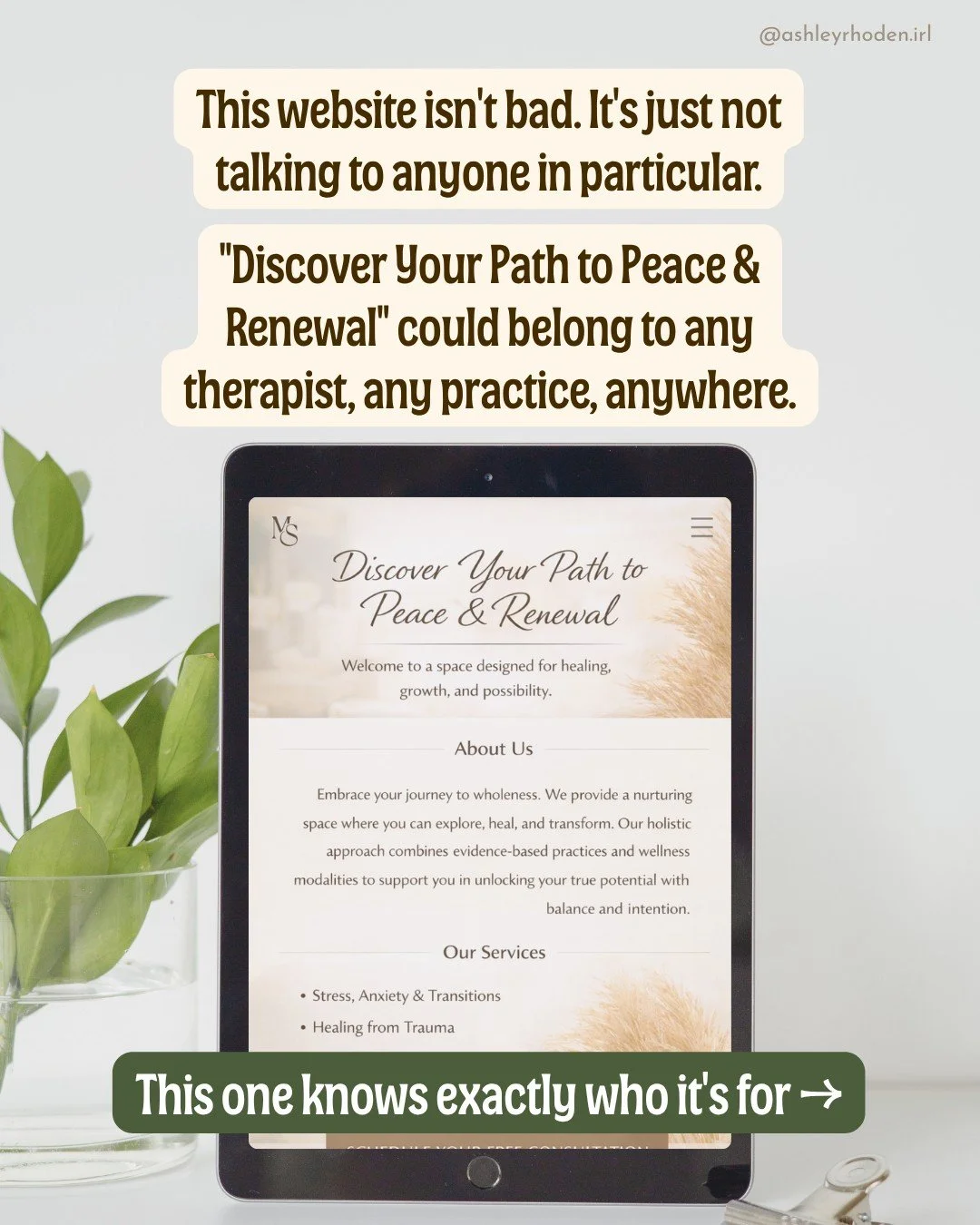
Here's a quick way to check yourself. Read your homepage and swap your practice name with another therapist's. Does it still sound the same?
If your site says "I see young women who struggle with anxiety," that could be anybody. Any therapist with the right training could say that. That's a branding problem.
Now compare it to this: "I work with young women, usually 13 to 17, whose anxiety is tied to their relationship with their mom." That's specific. You clearly know who you're working with. If your messaging already sounds like that, your problem is probably design, not brand.
There's an opposite version of this problem, too. Most of us are verbal processors, so we explain. And explain. If your site does far more explaining than it does resonating, reflecting, and validating, that's also a branding conversation. It usually means you haven't yet decided who you're leading with and which part of your professional identity comes first.
And if you know exactly who you want to work with and your copy is the right length, even if it isn't tight yet, you may only need a tonal shift or a refresh.
A story: she asked for a rebrand
I had a consult recently with a clinician who wanted a rebrand. Her site was already strong, she had a copywriter, and she loved her colors. She told me her homepage was boring.
But when I looked at it, it wasn't boring. It was inaccurate. It hadn't changed since 2019 or 2020, and what she wanted now was different: workshops, speaking engagements, continuing education, courses. That's repositioning, not a rebrand.
I also told her something I'd tell you. A new homepage with brand new copy will not, on its own, get you booked for speaking gigs. What she might actually need first is a publicist, someone who can make introductions and tell her how she's positioned to the people who hire speakers. PR isn't my bread and butter. I'd be curious what a publicist says before we touch anything, because the fix might be as simple as rewriting the copy, swapping a couple of images, and softening the edges.
So how do you know it's worth it?
This is the question I ask every potential client, and I'll ask it of you: how do you know this will be worth it?
I ask because a new website is not a magnet. Plenty of people assume the right clients will flock to a fresh site. They won't. A website supports your marketing. It is not your marketing.
Before you invest, ask yourself:
What am I hoping to get out of this?
What could I do before building a website? Unless you go with a template, a custom site is a real expense. If you're still working to cover your overhead, a website might not be the right move yet.
Am I ready? You're probably ready if your caseload is steady, your directory bio is strong, you're active in a few places, and you want to expand your professional identity. Or you have a PhD and want to publish your research so you can get booked to speak.
Can I keep it up? A site needs ongoing care, especially a blog and your copy. You need either the budget for someone to make regular updates, or the time and motivation to do it yourself.
Before you hire anyone, think like a business owner
If you've decided you want a site but you're not sure where to start, start here. Think about your practice as a business. Most of us come at it from a place of needing it to make money. Try coming at it from creativity instead.
Can you say what makes the way you practice different? Can you picture, really picture, the kind of person who comes to you? Not a stereotype or a demographic, but actual people. If you had to describe your primary population to a marketer, not another clinician, could you do it in enough detail?
If the answer is "not yet," that's fine, and it's useful. It means the first step is figuring out your niche and who you want to attract, and that comes before any design or layout work. It's also the heart of branding for therapists.
Not sure which one you need? That’s okay.
If you read this and you know something needs to change, even if you can't name it yet, that's a good place to be. I'd love to give you my two cents, or work with you even if you're not sure what you need.
The best thing you can do before reaching out is write down how you describe what's not working, in your own words. I want to hear how you say it, because that's the language we'll build with.
If you want my two cents, check out my quiz. No paywall, no email collection — just my honest feedback. I’ll tell you if you don’t need me.
If that’s the case, change something. Start with How to Write Therapy Service Pages That Don't Sound Like a Diagnosis Checklist.
Ashley Rhoden is a former corporate marketing leader turned strategist and website designer who works with therapists and private practice owners ready to stop being invisible online. She's also a grad student in a counseling program — not a therapist, not pre-licensed, just someone who understands this world from both the marketing side and the inside of a counseling program, and brings both to every website she builds.
Work with her to build a website that’s as unique as your sessions are. →